Visitors

Mittwoch, 15. April 2015

Europe’s Stand to the Death Penalty

In our last week’s post you have been told interesting information about the death penalty in the United States and important events in the early and mid-20th century.
Today we will give you an insight into the developments in Europe concerning death penalty

The death penalty has been completely abolished in all European countries, except for Belarus and Kazakhstan.
Of all modern European countries, San Marino and Portugal were the first to abolish capital punishment.
In 2012, Latvia became the last EU Member State to abolish capital punishment in war time.
As of 2013, in Europe, the death penalty for peace-time crimes has been abolished in all countries except Belarus, while the death penalty for war-time crimes has been abolished in all countries except Belarus and Kazakhstan.
Except for Belarus, which carried out an execution in 2014, the last executions by a European country occurred in Kazakhstan (which is partly in Asia) in 2003, and Ukraine in 1997.
The absolute ban on the death penalty is enshrined in both the Charter of Fundemental Rights of the European Union and the European Convention of Human Rights of the Council of Europe, and is thus considered a central value.
  
Although Russia is no member of the European Union, it is worth mentioning that in Russia the death penalty has been indefinitely suspended (under moratorium), therefore the country is de facto abolitionist (in practice).


The abolition of the death penalty became a real trend since the end of World War II when human rights became a particular priority.
In 1950 the European Convention on Human Rights was adopted, however, some countries took many years to ratify it. The United Kingdom retained the death penalty for high treason until 1998, however, this rule was superseded by the absolute ban on the death penalty in 1976. William Joyce was the last person to be put on death row for high treason in the UK, on January 3, 1946.

2009 was the first year that no one was executed anywhere in Europe, however, in March 2010 Belarus executed the last two people on its death row.

The European Union has been against the death penalty for a very long time, supporting the European Convention. Its 2000 Charter of Fundamental Rights included an absolute ban on the death penalty in all circumstances. The Charter has been made legally binding by the Treaty of Lisboa as it got fully ratified and effected on December 1, 2009.
The treaty has also a provision for the EU to join the Council of Europe and accede to the European Convention on Human Rights. The EU has been an active advocate of abolish the death penalty worldwide and has been promoting a United Nations moratorium on the death penalty, however, some national governments such as Poland have opposed such moves.

A prerequisite for membership in the Council of Europe is abolition of the death penalty. As a result, no execution has taken place on the territory of the organisation’s member states since 1997 which is a great step forward!
The capital punishment issue is continuously monitored by the Parliamentary Assembly of the Council of Europe. The current General Rapporteur on the abolition of the death penalty for the Parliamentary Assembly is French member of parliament Marietta Karamanli.

Death Penalty in the 21st Century
The only countries in Europe to have executed in the 21st century are:
- Belarus (last execution in 2014)
- Kazakhstan (last execution in 2003)

No member of the Council of Europe has carried out executions in the 21st century. The last execution on the present day territory of the Council of Europe took place in 1997 in Ukraine.
  

EU’s Import Ban on the Substance of Lethal Injection
Knowing about the current situation and opinion of death penalty within Europe, the United States of America should maybe think over abolishing this cruel way of killing criminals, as well, however, everybody has to build their own opinion about this sensitive topic and for sure, everybody has their own opinion regarding the death penalty.

One reason for the United States to prohibit death penalty would be the EU’s embargo on the substance thiopental sodium they use for lethal injections in the States.
Europe is, as mentioned above, absolutely against death penalty and stopped the import of this substance into the United States in 2011. The States, however, did not think over their current situation with death penalty - quite the opposite, in fact – they started researching on their own substance and managed to do so.
They began to use a toxic cocktail of three substances:

midazolam (leaves the doomed man unconscious)
vecuronium (paralyzes)
potassium chloride (stops the heart beat)


My colleague Christoph already mentioned this in his last week’s post:
With one person, Clayton Lockett, this toxic cocktail failed as the midazolam substance did not work, and the man had to suffer 43 minutes as this substance of the lethal injection was not as “effective” as the substance Europe had imported before.

Can you even imagine how cruel this is?
It is horrible and sad that in our modern society something terrible like this could even happen!


October, 10 – European Day
Against Death Penalty
There is no doubt – the European Day Against Death Penalty on October, 10 can certainly be justified. Even though, a lot could be achieved in terms of abolishing the death penalty, a worldwide unified regulation of prohibiting the capital punishment is still pending as the death penalty is still applied in approximately 68 states such as China, North Korea, Japan, Iran, Iraq, Saudi Arabia - to name but a few.
In some states, corruption, theft, kidnapping or drug trafficking is enough reason to be put to death! 
In Islamic countries even adultery, homosexuality or apostasy are considered to be crimes which are to be punished with the death penalty - this is incredibly insane!

There is still a lot to do in order to manage that there is a world-wide abolition of the cruel capital punishment. Organizations such as Amnesty International as well as numerous citizens’ movements will continue standing up for the abolition of the death penalty for good. As long as there is no worlwide ban on the capital punishment, many human rights organizations will not stop fighting against it and putting theirselves out for a world free of death penalty!


Next week:
Since we thoroughly talked about the death penalty we would like to show you the ropes of another sensitive issue, the right to bear arms, i. e. gun ownership in the States.
Keep your eyeballs peeled for our next blog post!

  
Bibliography:
www.wikipedia.org
www.google.com
www.youtube.com

Mittwoch, 8. April 2015

"The Death Penalty...


(…) is discriminatory and does not do anything about crime.” (Bobby Scott, US politician)

“I support the death penalty. But I also think there has to be no margin for error.” (George Ryan, US politician)

These are only two of countless opinions (and actually almost everyone has an opinion) about the death penalty in the United States – a topic which makes the feelings run high. This article is to give you a further insight into its development in the course of the twentieth century as well as events that occurred within the last fifteen years.

Important Events in the Early and Mid-20th Century

The Progressive Period (also Progressive Era or Progressivism; 1890s-1920s) may had its roots as a social movement, e. g. poverty, violence, greed, racism or class warfare, however, it also brought about some changes in connection with the death penalty since it grew into a political movement. From 1907 to 1917, six states completely repealed it, and another three limited it to the rarely committed crimes of treason and first degree murder of a law enforcement official.


In 1901, when Theodore Roosevelt was elected president the Progressive Era gained a strong voice on a national level. There is, however, the thing that a mood is like a pendulum – it swings from one side to another and thus it was that these above-mentioned reforms did not last long. The atmosphere in the United States was frenzied due to the threat of an impending revolution in the wake of the Russian Revolution. In addition, the US had recently entered World War I, and there were intense class conflicts emerging. Between the 1920s and the 1940s the American abolition movement lost support.


Can there be a more humane way of executing inmates?


In fact, is there a humane way at all – and who defines what is humane and what cruel?


Being the first state ever to do so, Nevada introduced the use of cyanide gas in specially built gas chambers in 1924. Today, four other states apart from Nevada authorise lethal gas as a method of execution: California, Arizona, Mississippi and North Carolina.

Eighth Amendment to the United States Constitution (ratified Dec 15, 1791)
“Excessive bail shall not be required, nor excessive fines imposed, nor cruel and unusual punishments inflicted.”

It appears that the governments decide on whether a form of punishment is cruel – and we elect these people. So is it really us who make this decision of vital importance? Don’t worry! It would be wrong to address this matter in this way since everyone has a different opinion and a government’s ruling does not necessarily have to comply with your point of view.
1930s: Executions carried out in the United States reach the highest level in the country’s history with an average of 167 per year; furthermore, the number of death sentences carried out between 1925 and 1949 peaked at a total of 3,644. It is assumed that the reason for this is due, in part, to the writings of criminologists, who said that capital punishment was necessary as a social measure but allegedly also due to the fact that Americans were suffering through Prohibition and the Great Depression (Schabas, 1997 and Bohm, 1999)


It appears to be quite ironic when you read the United Nations General Assembly adopted the Universal Declaration of Human Rights in 1948 proclaiming a “right to life” and the United States was among the countries to vote in favour of the Declaration, yet still carrying out the death penalty on its own property.

By the 1950s, the public began to turn its back on capital punishment and the number of executions dropped dramatically.

Recent Developments


The state of Oklahoma was the first state to introduce lethal injection as a means of execution in 1977 and in 1982 the Texan inmate, Charles Brooks, Jr., was the first prisoner to be executed using this method. His last meal consisted of a T-bone steak, French fries, ketchup, Worcestershire sauce, biscuits, peach cobbler and iced tea.


In 2011, Texas stopped granting last meal requests to condemned inmates due to an incident that occurred with Lawrence Russell Brewers execution who ordered a large special meal (consisting among many other dishes of two chicken fried steaks smothered in gravy with sliced onions; one pound of barbecue with half a loaf of white bread as well as a slab of peanut butter fudge with crushed peanuts), but he then refused the meal when it arrived.


The US Supreme Court ruled on June 26, 1986 that execution of insane persons was an unconstitutional violation of the Eighth Amendment adding just two years later in 1988 that individuals under the age of 16 cannot face capital punishment (in 2005, the Court held that the execution of an offender under the age of 18 is cruel and unusual and there unconstitutional).

“(…) nor cruel and unusual punishment inflicted.” – Eighth Amendment.

The topic of the death penalty has ever been highly controversial, though-provoking and therefore often been a matter of heated debates not only about pros and cons but also its constitutionality considering moral questions, the occurring costs and various other aspects such as, for instance, botched executions:


April 29, 2014. Oklahoma. Despite defence attorneys having frequently warned about the dangers of using an experimental drug protocol, Oklahoma scheduled the execution of Clayton D. Lockett and Charles Warner.

An hour before the execution of Mr Lockett began, the governor, Mary Fallon, was notified that the executioner was having problems finding a usable vein, but she did not intervene. After the first drug, a sedative, was administered and Clayton D. Lockett was announced unconscious and therefore ready to receive the other two drugs that would actually kill him, Mr Lockett was found not to be unconscious. Three minutes after the latter two drugs were injected, “Locket began breathing heavily, writhing on the gurney, clenching his teeth and straining to lift his head off the pillow.” The blinds were lowered to prohibit witnesses from seeing what was going on; 15 minutes later the witnesses were ordered to leave the room; 43 minutes later: Clayton D. Lockett died of a heart attack, while still in the execution chamber. This is, however, not the only example for botched executions.

The media, as always, also plays an important role in the formation of opinion about a certain topic and the death penalty marks no exception. When the film Dead Man Walking, starring Susan Sarandon and Sean Penn, was released in 1996, it invigorated the debate on capital punishment. The film is based on the novel by Sister Helen Prejean who released her book of the same name about her role as spiritual adviser for two death row inmates in 1994.


Next week:
Europe’s role in US executions.
Moreover, we would like to recommend the following link:
Death Penalty


Bibliography:
Google
Wikipedia
Brainy Quote
Death Penalty Info
Death Penalty Abolitionist Movement
Death Penalty Pro and Con
Progressive Era

Montag, 23. März 2015

After talking about the Constitution of the United States, speaking about the Supreme law and in detail about the Bill of Rights and how to conjure a Bill into the law, we want to discuss issues like death penalty, gun ownership, abortion and the gay marriage. In our today´s post we will start to talk about death penalty and it’s beginnings in the USA.

Death penalty- how it was introduced

When death penalty was introduced in the United States of America, Britain was the country that influenced the United States more than any other country. When the settles came to the new world the years after 1492 they brought the practice of death penalty ( in law language: capital punishment). The execution of Captain George Kendall in 1608 in the Jamestown colony of Virginia was the first recorded execution in the new colonies. He was executed for allegedly spying for the Spanish Government. In 1612 the Virginian Governor Sir Thomas Dale enacted the divine, material and moral laws which provided the death penalty as well for as punishment for minor acts such as stealing grapes and vegetables, killing chickens, rejecting the idea of one god and trading with Indians. Hanging was the preferred method of execution, however method like burning, beating and breaking on a wheal where also used, but were infrequently. From colony to colony the laws about death penalty differed from one another.

The Abolitionist Movement

The abolitionist movement began early. It was the essay of Cesare Beccaria's, which was published in1767 with the title “On Crimes and Punishment “that had a strong impact throughout the world. In the essay, Beccaria stated that there was no justification for the state's taking of a life. The essay gave abolitionists an authoritative voice.
American intellectuals as well were influenced by Beccaria. The first attempts to reform the death penalty in the U.S. occurred when founding father Thomas Jefferson introduced a bill to revise Virginia's death penalty laws in 1777. The bill proposed that capital punishment  should be used only for the crimes of murder and treason. It was defeated by only one vote.
However in 1790 the US Bill of rights ended its 8.amendment saying that “no cruel and unusual punishment would be inflicted on united states citizens”.
In 1794, Pennsylvania abolished the death penalty for all offenses except first degree murder.

States, which did not introduce the capital punishment

However, some states never introduced the capital punishment, such as Michigan. The newest states on that time, Alaska and Hawaii, repealed the death penalty prior to statehood. Other states with long histories of no death penalty are Wisconsin (the only state with only one execution), Rhode Island (although later it was reintroduced, not used and abolished again), Maine, North Dakota, Minnesota, West Virginia, Iowa, and Vermont. The District of Columbia has also abolished the death penalty; it was last used in 1957. Oregon abolished the death penalty due to an overwhelming majority in a public referendum held in 1964. However, reestablished it in a death penalty/life imprisonment referendum in 1984.


On this map you can see in green the stats that did not introduce the capital punishment and in red the states that introduced it make use of it.


Although some U.S. states began abolishing the death penalty, most states held onto it. Some states made more crimes capital offenses, especially for offenses committed by slaves. The 1838 enactment of discretionary death penalty statutes in Tennessee, and later in Alabama, were seen as a great reform. This introduction of ordering discretion in the capital process was perceived as a victory for abolitionists because prior to the enactment of these statutes, all states mandated the death penalty for anyone convicted of a capital crime, regardless of circumstances.
During the Civil War there was more attention given to the anti-slavery movement. After the war, new developments in the means of executions appeared and eased its use. The electric chair was introduced at the end of the century. New York built the first electric chair in 1888, and in 1890 executed William Kemmler. This method was considered to be more human than hanging and it was quickly adopted by other states.


Source:
https://www.youtube.com/watch?v=W_mb7tuNJS0
http://en.wikipedia.org/wiki/Capital_punishment_in_the_United_States


Montag, 2. März 2015

The Game of Life & Law


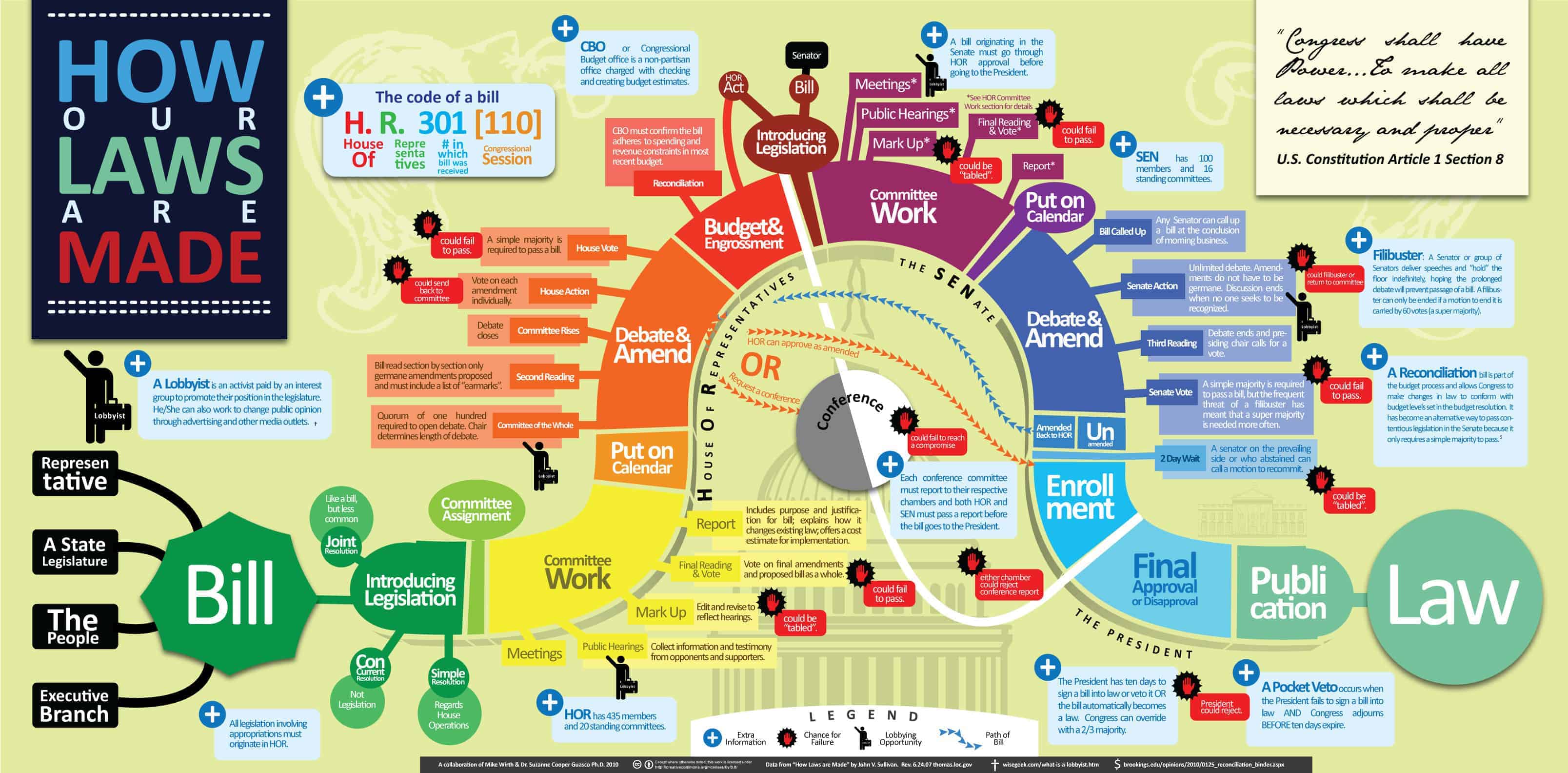
To understand the inner workings of conjuring a bill into a law: Roll the dice!
With the aesthetics of  the modern version of The Game of Life, today’s infographic thoroughly walks us through the trip a bill takes from introduction into the House of Representatives through publication as an official law.

http://dailyinfographic.com/wp-content/uploads/2011/07/howlawsmadeWIRTH21.jpg

 “the journey of life is governed by a combination of chance and judgment.” Milton Bradley


In 1860, the year Abraham Lincoln was elected President, Milton Bradley invented America's oldest, and probably most popular board game "the Checkered Game of Life"

Here a short introduction to the original rules (highly relevant, not just "on board"!):
Play starts at a square labelled Infancy and ends, usually but not always, at Happy Old Age.
It simulates a person's travels through his or her life, from college to retirement with jobs, marriage, and possible children along the way.
Like many games back then, it had a strong morals implied:
There are good patches, and bad, in roughly equal number. On the one hand: Honesty, Bravery, Success. On the other: Poverty, Idleness, Disgrace.The game illustrates late-eighteenth century social values assigned to various careers. Just like in real life, those values experienced an immense renewal over time.
Having survived its founders death in 1911, the Depression and the two World Wars, the original checkered Game of Life changed to only "Life". It bears almost no resemblance to its nineteenth-century predecessor.

Comparing the rules of a game with the complexity of law-making might surprise you, but...

 ...imagine a game in which the play is brought to a standstill because of  a conflict in the rules.Obviously such a game is less fun and furthermore violates the canon of game formation requiring it to be playable to its conclusion. In such a case, the players have two alternatives to play on: they may abandon the game or save the game by altering its rules so that the conflict will not reoccur. Given that the principles were adopted in the first place because they were believed to identify Right and Wrong makes the "ruling" of the whole game a challenge for a life time.
The process of law making  is therefor just as complex and flexible. In the Game of Life, on board and reality, there are certain rules applied. Firmly established and unchangable, based on universial morals and common sense - but there will always be room for improvement or need for readjustments, according to constant changes of life in the real world.

"That's life!"


Montag, 23. Februar 2015

Bill of Rights of the United States of America: Its beginnings


Created:

September 25, 1789
Ratified:

December 15, 1791

Location:
National Archives
Author(s):

James Madison


“A bill of rights is what the people are entitled to against every government on earth, general or particular, and what no just government should refuse, or rest on inferences.” -Thomas Jefferson


If you are interested in finding out more about the creation of the most important unit in the U.S. Constitution, the “Bill of Rights”, you should continue reading our today’s blog post. 
Firstly, we tell you something about its origins and beginnings and later on we will tell you more about the content and the importance the Bill of Rights have for U.S. citizens.
Secondly, you will have a better understanding of how American population is working and thinking about certain subjects in modern society. 
Finally, you may be able to understand the feelings of U.S. American citizens, in general, when it comes to issues like gun ownership, death penalty, abortion, right to vote, etc. as sometimes, we are not able to make sense of American behavior regarding laws and verdicts in the U.S. judicial world.


The first ten amendments to the U.S. Constitution are called the Bill of Rights. They were added three years after the Constitution was ratified, i. e. in the year 1791. 


In 1789 they were created by James Madison, the 4th President of the United States (1809-1817). During his term he conducted the American-British war, also known as the “second War of Independence”.


The role model for the American Bill of Rights was the English Bill of Rights created back then in 1639 and earlier English political documents such as Magna Carta (a charter agreed by King John of England at Runnymede near Windsor, on 15 June 1215). The English Bill of Rights set out certain rights of individuals including the prohibition of cruel and unusual punishment. and reestablished the liberty of Protestants to have arms for their defense within the rule of law. Here you can note one example of connection to the American Bill of Rights, the right to bear arms that is still today of great importance for U.S. American citizens.


The reason why the Bill of Rights was added to the Constitution was, the people were afraid the federal government would have too much power. The Constitution was still a very young establishment therefore the final touch was still to be made.

The Bill of Rights protects the most important freedoms of U.S. citizens and limits the power of the federal government. At first, the Bill of Rights only applied to the federal government, but now it also applies to the states.


The Bill of Rights had little judicial impact for the first 150 years of its existence, but was the basis for many Supreme Court decisions of the 20th and 21st centuries. One of the first fourteen copies of the Bill of Rights is on public display at the National Archives in Washington, D. C.


The first amendment of the Bill of Rights is probably the most important one. 
It includes freedom of


·         Religion

·         Speech

·         Press

·         Assembly

·         Petition


Freedom of Religion means you can practice any religion you want or not practice a religion at all.

Freedom of Speech means the government can't stop people from saying what they think.

Freedom of Press means the government can't control what the media writes.

Freedom of Assembly means people can protest by having rallies or marches.

Freedom of Petition means people can request that the government change things.


The Second Amendment is also worth and important to mention. It includes the right to bear arms. This law is considered to be strange and dangerous by at least the European part of the world.


Please see below the Preamble of the Bill of Rights that provides you the reason why people decided on adding the Bill of Rights to the Constitution, namely, they were afraid of the fact the government would abuse its powers, as already mentioned above.


Preamble

Congress of the United States begun and held at the City of New-York, on Wednesday the 4th of March, 1789.


THE Conventions of a number of the States, having at the time of their adopting the Constitution, expressed a desire, in order to prevent misconstruction or abuse of its powers, that further declaratory and restrictive clauses should be added: And as extending the ground of public confidence in the Government, will best ensure the beneficent ends of its institution.

RESOLVED by the Senate and House of Representatives of the United States of America, in Congress assembled, two thirds of both Houses concurring, that the following Articles be proposed to the Legislatures of the several States, as amendments to the Constitution of the United States, all, or any of which Articles, when ratified by three fourths of the said Legislatures, to be valid to all intents and purposes, as part of the said Constitution; viz.

ARTICLES in addition to, and Amendment of the Constitution of the United States of America, proposed by Congress, and ratified by the Legislatures of the several States, pursuant to the fifth Article of the original Constitution.


In the following you can see a list of the Bill of Rights in shortened form:


We would be happy if we cleared things up for you regarding the Bill of Rights in the Constitution of the United States of America. Hope to have you back soon for some more details about current, important legal affairs in the States and how they are linked to the Constitution.


Source: